Note - the first part of this article is about my Albany tournament, and the second are some tips I learned from this event on how to handle a disastrous tournament.
I was very much looking forward to the most recent edition of the Albany July 4th tournament. For CSW players, this is absolutely the toughest field for any event in North America, and outside of Causeway, possibly the hardest in the world. This is mainly due to Bob Linn’s generous donations to the prize fund, which draw many of the top players in the world. In fact, six of the top 20 in WESPA were present - Nigel Richards, Adam Logan, Wellington Jighere, Alec Sjoholm, Dave Wiegand, and Josh Castellano.
I had been on a pretty long hiatus since 2020, having only played the CoCo Championship in Seattle in fall 2023, the Word Cup in summer 2025, and NOLA in January 2026. I started studying quite intensely again in the spring of 2025, and was happy with my performance in those last two tourneys, all things considered. I earned my second master norm at NOLA, going from 1793 to 1827. Thus I came in to Albany with a WESPA rating in the low 1800s, needing to win only 40% of my games and finish above 1800 to get my WESPA master title. I felt this was definitely doable.
Part 1 - The Tournament
Early Bird + Day 1
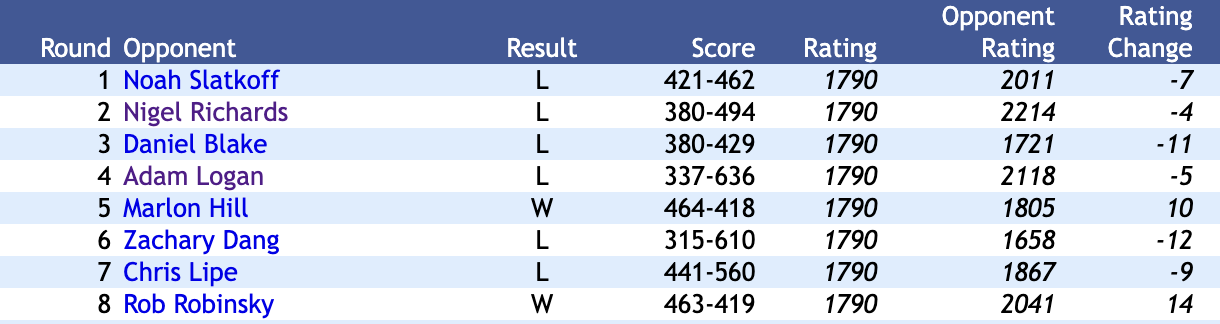
I ended up playing in the early bird, which did not go well including getting a 3x3 but still losing 450-474 to grandmaster (and recent SPC CSW champ) Josh Castellano. For the main event, I started with Noah Slatkoff - a close game, but I was unsure about CAtHOOD (DOGHOOD* is not good, just GODHOOD) possibly did me in. Not only that, but I had Nigel Richards in my group, who beat me pretty badly, and lost the third game as well. At 0-3, I thought perhaps I would have an easier opponent, but was paired at table 22 with Adam Logan! He got out to big lead early, so I tried to open up the board in desperation, which only made things worse. H ended up with 636, beating me by ~300 points. I won against Marlon Hill (one of the most entertaining opponents of all time), before being completely beat down by Zachary Dang. This was a game where I went for a big Q outbingo in two spots, but he had the only bingo possible on his rack and went out. This was my second loss to a 600+ score in six games.
I then lost another very frustrating game to Chris Lipe at the bottom table (where I would spend much of the rest of the event), as after finding my only bingo with HELIAcA(L) I drew seven consonants, including a Q. I also, with a rack of U?, drew AEUVY on an earlier turn. I was fortunate to beat a very strong player who I have played more than anyone, Rob Robinsky, to avoid being in last (at least for day one).
Day 2
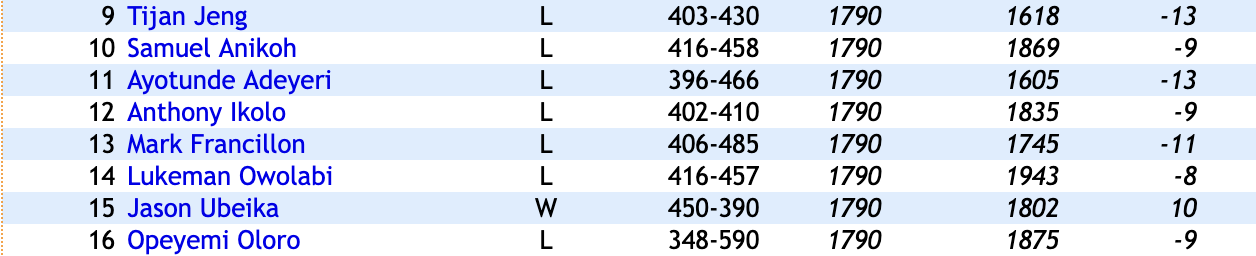
Day 2 was, somehow, even worse. I do not remember many details of the earlier games, but in one game, I had my opponents rack wrong by one tile (I thought it was AINORSY but it was AEINORS) which gave him an out bingo to win. I missed an out bingo in one game where I had to make A(WASH) in the process. In my loss against Mark, I, for the first time in this event, lost a turn, however this was at the end and more a result of frustration than anything else. In my last game, my opponent had both blanks and played I believe five high probability bingos.
Day 3
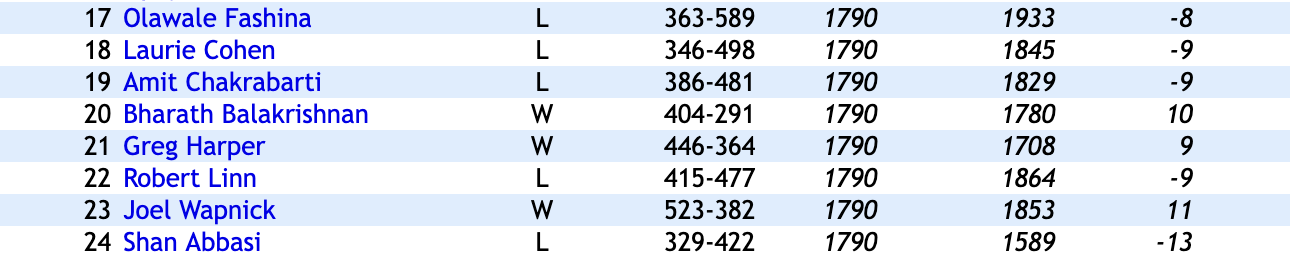
On day 3, I figured my first game could not be worst than my last. This time I had both blanks, but my opponent triple-tripled through a bingo that had gotten me back in the game then played several more bingos. My opponents in these two games scored 590 and then 589! In both cases I was in the 300s. This has to be one of the highest opponent scores in back to back games ever. In my game against Laurie Cohen, for the first time I lost a turn on a play I thought was good (FERALLY*) and it went downhill from there. I was able to win back to back games (the only time in this tourney I won back to back games, including the early bird). Probably the only “easy” game of the tournament was against Joel Wapnick, particularly with him not blocking a natural V(E)XATION. In my last game, I misremembered that FUBAR could be a noun, trying FUBARS*, losing my turn in the process early in the game.
Day 4
On the last day, I went winless, trying GUBAR* (GHUBAR, GOBAR and GEBUR are valid) against Mohammad Sulaiman, and inexplicably allowing Jason Keller to play RETICULI*. Thankfully I got a bye in the last round, which was fine by me.
When I looked at my tourney statistics, one thing really stood out. My scoring average was 402, which was tied for second worst. My opponent scoring average was 465, the highest by 14 points! My performance rating, at least according to WGPO, was 1418. The last time I had a PR anywhere near this was 2011, two years before I switched to CSW.
As a comparison point, my average was 421-436 with a PR of 1878 in NOLA 2026, and 432-449 with a PR of 1862 in the 2025 Word Cup. This spring, I also had followed Austin’s suggestion of looking at every single bingo (again), which took me a couple months. I missed around 3% of them on average, which I put into a separate cardbox quiz. I also started reviewing some strategic concepts with a coach. Despite that, I ended up winning 21% of my games in this tournament, which I hope is not only my worst tournament ever, but will be the worst tournament of my life. I will also mention that I just played in the SPC in Iowa, and while I didn’t do great (13-18) compared to Albany it was practically Xanadu (425-436 with a PR of 1739).
Part 2 - Psychology
Despite this absolutely horrible tournament, I was very happy with how I handled my games, both in game and afterwards. I have never been someone that gets really upset due to game results, but I’ve definitely not handled it as well as I could have in the past. This is what I think really helped me, and I hope can help you as well.
During the Game
1) Do your best to not give away information to your opponent. In my experience, most players use body language or even say things that tell their opponent about their tiles, especially when they are bad. A frustrated sigh when seeing your tiles, shaking your head, or any other negative emotion will only give information to your opponent. Ideally you should have the same reaction no matter what tiles you draw (and that reaction is nothing!). Despite being a real “chatty Cathy” I tend to say little during games when what I say could be considered telegraphing my feelings about the game or my tiles.
Another thing to avoid, which I notice at times, is to not start to score a play after your opponent sets it down (but before they hit their clock). Also avoid nodding your head, saying “yep” or anything else that would communicate that you are going to accept the play. There have been occasions where I play something that I’m unsure of, but my opponent’s reaction to it (in a way mentioned above) signifies to me that they will not challenge. On the opposite end, some players will specifically not score a play when they plan to hold. Ideally, you should simply not react at all in either situation until the play is committed.
2) Be sure to remain respectful to your opponent when you are losing. Good sportsmanship is always important. No matter how bad things got, I made sure to say amicable, offering a handshake and a “good game” regardless of the outcome. We all are hear to play the game we love so much, and bad luck happens to everyone.
3) Avoid frustration plays. These are plays that are either too reckless, or are words your brain tells you are likely phony, but you play anyway out of frustration. This will only make a bad situation worse.
Between Games
1) Take a break - stepping away from the playing room between games or getting some air can help quite a bit after a particularly frustrating loss (or streak of losses). Venting to other players can also be very helpful!
2) Be careful about analyzing games or racks immediately afterwards. Some players do this and find it helps them to know whether they made any big errors (vs. just having bad luck), but this can also backfire. If you do find you made a big mistake, it may make you feel worse than if you hadn’t looked at all.
3) If you are on a losing streak, consider recording racks for your next game. If you do this, I recommend looking at the game(s) at the end of play for the day - this way if you do find something frustrating, you at least have some time to process before your games the next day. You can also just wait until the end of the tournament - it’s just whatever works best for you.
End of Day and End of Tournament
1) Engage in activities you enjoy that aren’t Scrabble! For me, this means socializing with others over a meal, drink etc. Or maybe visit something unique to the city you are visiting. But this could just be anything you find fun.
2) If possible, combine your tournament with a visit to a nearby area. When I went to my two WSCs, I combined them with a trip to other parts of Europe. After Albany, I visited NYC for a few days and had a great time!
3) Remember why you went to the tournament. In the end, we all play these events because we enjoy them, and to see others who enjoy the game so much as well. And with so much luck involved, pinning your enjoyment and how you do isn’t helpful. In the SPC, despite a good start I was 0-7 on day 2. But top expert and former world champion Wellington Jighere was 1-6 on day 3, and Alec Sjoholm was 1-6 on day 1! Remember in each tournament, no matter how strong the field, half the players are losing in any given game.
4) Reflect on the role luck plays in the game. One good way to assess this is number of blanks drawn - something well below 50% indicates unfortunate drawing. For me, the scoring averages told a similar story. Look at how you’ve done in other tournaments to compare, and realize sometimes these things just happen.
I know these tips are much easier said than done! But I hope they help you in some way. And no matter how bad a game (or games) get, there’s always the next one. As for me? I’ve already signed up for three more tournaments, and next July 4th, I guarantee you I’ll be back in Albany.