Note: I play in the CSW24 lexicon, but these principles are 100% lexicon-neutral.
A topic that I think is rarely if ever discussed with regard to overall play is how you use your equipment during the game. By that I don’t mean the board itself, but your scoresheets, tracking, and everything else you write down. It may seem pretty straightforward - write down racks, plays, scores and track, but there’s actually a lot more to it than that.
The first thing you should do is have a process for recording plays, tracking and drawing new tiles. Why is this so important? The main reason is to help with tracking errors. From what I have observed about my own play, these errors are almost always due to interruptions in the game, for example score verifications or challenges. You may start to track, be interrupted by this, and then simply forget what you have tracked. There’s nothing worse than having a close endgame and not having the remaining tiles correct, especially if you are running low on time!
This is my personal suggestion for order, but like the rest of this guide, your personal preferences may vary. What’s most important is consistency. Note that these steps exclude plays where a turn is lost due to a successful challenge.
After your opponent’s play
-
Verify the score of the play and record the score.
-
Track the tiles played.
After your own play
-
Record the score of the play.
-
Draw tiles as needed.
-
Place the new tiles face down - do not yet add them to your rack.
-
Track the tiles played.
-
Place the new tiles on your rack.
As I mentioned, the biggest opportunity to make tracking errors is when the clock is stopped for any reason. In these cases, be sure to retrack tiles. If for example AHNT is played off, count the number of As, Hs, Ns and Ts on the board and make sure it matches up with the number crossed off on your sheet.
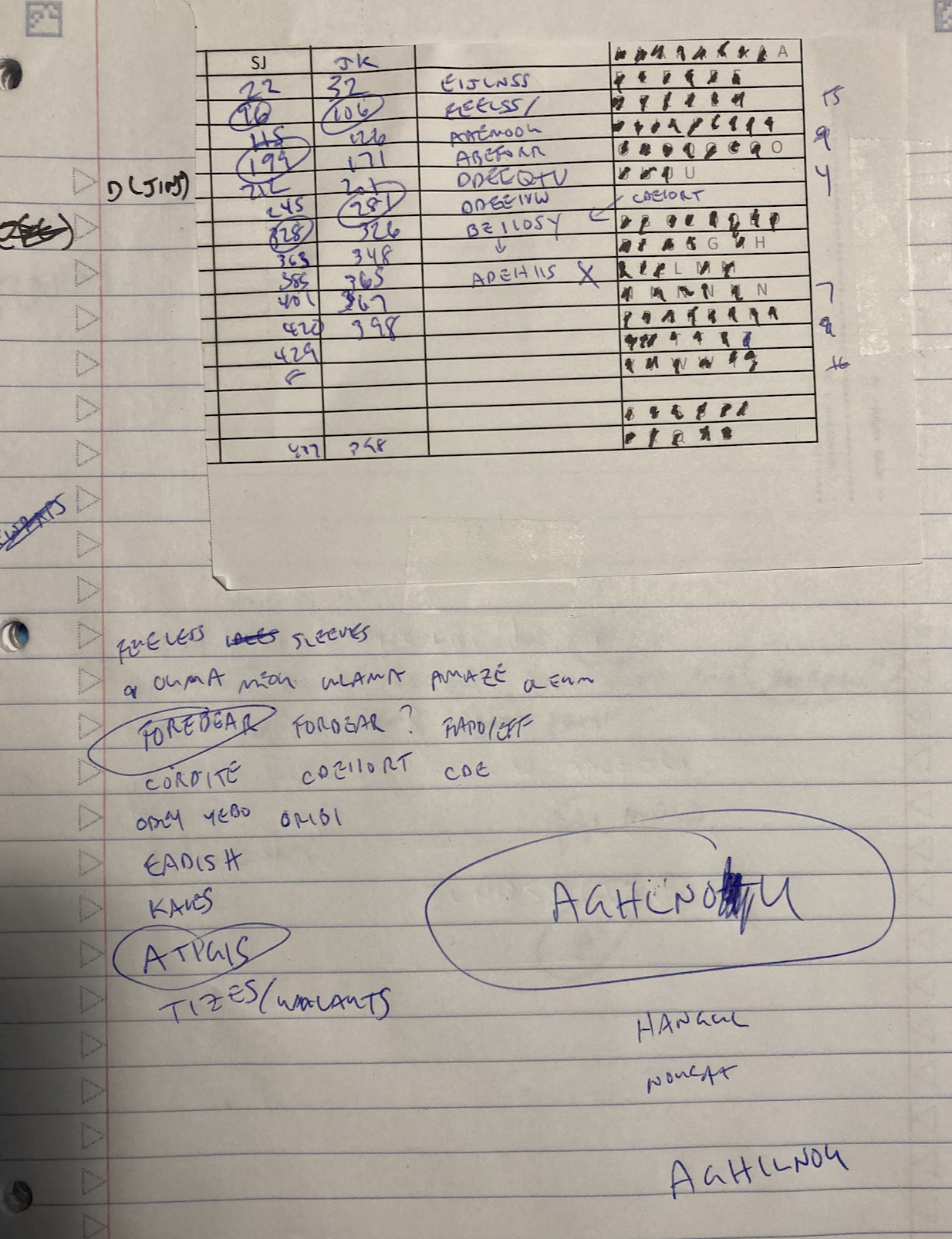
Scoring plays
When scoring plays, make sure your scoresheet has enough space such that the scores you record can be written clearly. I have on many occasions had an improper score due to poor handwriting (see top image!). If you wish to analyze your game, you should also record your racks but keep them concealed from your opponent (more about this below). For the plays themselves, you can either write them down, or just take a picture of the board afterwards. Having a scrabble grid on your scoresheet to write down each play can also be helpful!
Tracking plays
Ideally you should have a scoresheet with each letter printed out (again see picture). You want to do this in somewhat lighter ink. Why? This will make it more obvious when that letter is covered up. I also highly recommend crossing out letters with a dark marker vs. just pen or pencil (it may not be clear in the image, but I’m writing scores and racks with a blue pen, and crossing out letters played with a black fine tip marker). It can be very easy to make a mark over a letter and then be unsure later if it’s tracked vs. just being an errant mark. Using a dark marker and fully covering the letter will make things much more obvious.
Another thing I do in games is, once I get to the mid-late game, track tiles once they get on my rack vs. when they are played. Obivously you have to be careful when doing this to not double count, but knowing which tiles are not available to your opponent at this point is incredibly useful. For example if I have the Z on my rack, I know it can’t hit a hotspot I’m worried about - pre-tracking here eliminates that concern. On my scoresheet the “X” next to ADEHIIS indicates that I started pre-tracking at this point. A note about exchanging: if you feel you might need to exchange, do that first! Worst case scenario, if you pre-track and then exchange, circle the tiles you threw back in your tracking.
Vowel-consonant tallies
Another reason to pre-track is how much it may affect the vowel-consonant balance in the remaining pool For example if before pre-tracking there are nine vowels and nine consonants unseen, but my rack has six consonants and one vowel, then in reality the unseen pool is very vowel heavy! Information like that is incredibly important - in this case I would prioritize keeping my one vowel a lot more.
I also recommend, later in the game (around the same time you start pre-tracking) to keep a tally of how many vowels and consonants are unseen. In the picture above I did this very informally - writing the number of vowels and consonants unseen next to the two respective sections, and updating them after each turn. This is critical information that cannot quickly be gleaned from just looking at what letters are not crossed off.
In terms of the action order above (1-5), when pre-tracking you can add step 6 - place the new tiles on your rack separately (to avoid double counting), then pre-track them on your scoresheet. Then you can combine them with the rest.
In-game notes
For many of my turns, I wrote down various subanagrams of my racks, or plays they could make with available tiles on the board. I found this hugely helpful. You can see I put each turn on a separate line. I may even write down a phony hook (e.g. in one game CERATOID had been played, and immediately wrote down CERATOIDS*) so that I do not try to play it, and also to remember to remind me to challenge if my opponent does.
In the picture above, I had ABEFORR - I immediatley noted I had FOREBEAR through an E, and I circled FORBEAR to indicate I wasn’t 100% sure of it. It can also be helpful to just write down any 8s you see with a rack, as they may become playable after your opponent’s next turn.
I also highly recommend noting non-obvious hooks available as they come up. I did this in dark marker with D(JINS). While this is a word pretty much everyone knows, it is very easy to lose track of these as the game goes on. If that hook is taken or obstructed, you can simply cross it off. As another example, if EVEN is played, I would write down E/S/Y(EVEN).
Endgame notes
When the unseen pool is down to maybe 10 or less tiles, I write down each of those tiles in alphabetical order; in this case the last eight were AGHLNOTU. Then I cross out the tiles played in this list. This is helpful for looking for possible opponent bingos. After my opponent played the T, I crossed it out leaving AGHLNOU - no words here, and I noted that only one eight is made with this rack (S for SHOGUNAL) so I can make sure to block any such threats if available. I also wrote down a few subanagrams (like HANGUL) to help me identify possible plays my opponent could have on the board, including ones off whatever I played next.
Keeping this information private
To ensure you do not accidentally reveal any information to your opponent, I recommend either not placing your notes on the table (place them on your lap below the table for example), or keeping them hidden under a separate scoresheet. I purchased a large notebook that I can keep out of view, or I can close if I want to place it on the table.
Another option is to have a scoresheet that just shows plays and tracking, and then have a separate sheet below that where you write racks and notes. Then you can pull up the sheet to reveal this section as needed, while keeping that info safe when placed on the table.
In summary
How you use your equipment in game of course, is very personal! Maybe you want to use a big notebook, or a tiny sheet of paper. Maybe you want to use one marker or six. The principles I outline here are applicable no what your personal preferences. I hope this information is helpful to you in OTB play!