Note: this is the first in what I hope to be several articles related to word study. Any specific word counts and other statistics here are specific to CSW24 – however the exact same principles apply to the American word list(s).
When I first was introduced to competitive Scrabble in 2008, my biggest priority was to study not only as many words as possible, but to do it in the manner that was most beneficial. At the time, the only electronic resources available were Zyzzyva and Aerolith (which had recently launched, and had daily quizzes (Wordwalls) but no WordVault yet). I also picked up a copy of the Mike Baron WordBook.
Fast forward to the present day, and there are far more studying options available, making it easier to learn more, both faster and more efficiently: Xerafin , Anki , InfiniWords and StudyCade (we hope to provide more posts specific to these platforms soon). But for a new player, what is the best way to study to get the most “bang for your buck?” And as your word knowledge improves, how do you both continue to acquire new word knowledge but maintain what you have already studied? Note that many of these suggestions are somewhat platform neutral – use whatever app(s) that you like best! I would also imagine most players will be doing multiple quizzes at the same time, so feel free to start the next one in the list whenever you feel ready.
Brand new players
1) Study the two letter words. I simply exported the list from Zyzzyva and printed it out (this was before I had a smartphone!). You will find many of these are just common words that you don’t need to study – simply focus on everything else. There are 127 2s, so given how few there are I found it best to just look at them every day. You should try to have all these down as soon as possible, as they will be required to make parallel plays.
2) Study the three letter words. There are 1351 3s in CSW24. Similar to 2s, I would first note which ones you already know as common words. Since the list length is still pretty manageable, consider making a new list with those words removed.
For the three letter words (and longer), you have a few different options depending on your preferences. The first is to use a cardbox quiz, in a program like Zyzzyva and Anki. You may wish to simply put them all in one cardbox quiz, or add X at a time by probability. Probability is simply the likelihood of drawing the letters needed for that word - the more probable, the more likely it is to come up in a game.
Cardbox quizzes work by increasing the time until you see the alphagram each time you get correct in succession. If you ever get it wrong, it goes back to the first “box.” You can do these as flashcards or typing in the solutions – flashcarding is much faster, though typing is more helpful for some people. In Zyzzyva, here are the default cardbox windows, which can be changed if needed:
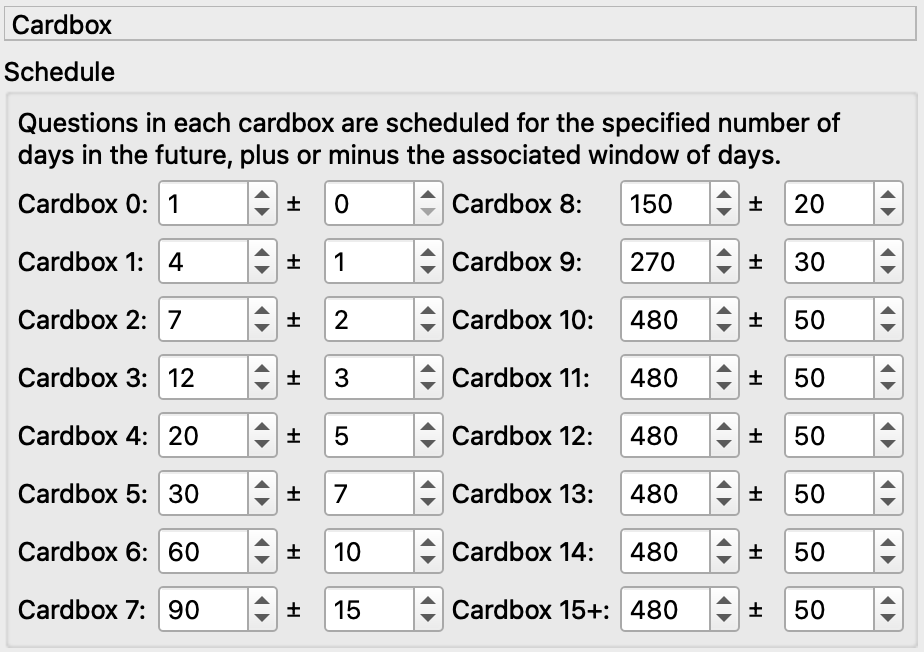
The cardbox method for Anki is considered to be more efficient for learning (where each word has its own specific set of windows for each box based on the learning history), though I personally find Zyzzyva easier to use on the front end.
An alternative option is to use something like Aerolith. There is a daily 3 letter word quiz with 50 alphagrams, and if you do this regularly you will end up seeing all the words over several months. However I would recognize starting with the cardbox quiz first, and then add in a program like Aerolith later.
One thing to note at this point, is that learning just 2-3 letter words as a new player will give you a huge boost to your performance in games. Studying is something that has diminishing returns (in that as you add more words that are less probable, those are less likely to come up), but these short words will always be useful to know. Also keep in mind that if at any point you don’t wish to go any further, that’s perfectly fine! Just find what’s best for you.
3) Study the 4s with JQXZ. Within this group I would suggest doing the Q words first, especially taking note of the Q without U words like QADI. These words are critical to take advantage of hotspots like the TLS to make very high scoring parallel plays.
4) Study the 5s starting with JKQXZ. These are great to take advantage of the segments on the second to last row and column from the end, where the TLS and DWS are five squares apart. For example, a five letter word starting with J that then reaches that DWS will be worth at least 56 points!
5) Study the highest probability bingos. There are a couple ways to do this for 7s and 8s. You can either do a quiz by probability (i.e. probability 0-100 for the top 100) or study words with the top stems, like AEINST for 7s or AEINRST for 8s.
A note about bingo probability: These graphs show the probabily rank of played bingos from an enormous set of computer vs. computer games (thank you to Erickson Smith for these). You can see that, for 7s, about 50% of all playable bingos are in the top 7000, and 75% in the top 14,000. For 8s it’s around 7,500 and 15,000 (there are ~34.5k and ~42.3k 7s and 8s in CSW24). It is important to note that since you are often drawing to bingos that are higher in probability in the first place by keeping very bingo-prone leaves, this is a bit biased. But it does still show the diminishing returns present when studying by probability, which is why focusing on the most likely bingos first is so crucial.
–

7s (above image)

8s (above image)
–
You may find that at some point you get tired of doing cardbox quizzes. If this happens at any point, there is nothing wrong with taking a break. You may also wish to switch over to doing daily quizzes in a program like Aerolith at this point as you are more entering “maintenance mode.” This applies to all steps in this article.
Okay, I want to take my studying to the next level. What now?
6) Study all other four letter words. My recommendation, like for most steps here, is to do a cardbox quiz by probability (just add as many or as little at a time as you feel comfortable with). One thing you will notice is that for four letter words especially, high probability words can have a LOT of solutions. Don’t worry if you can’t get them all. You don’t need to know all 10 solutions to AEST, and these come up so very rarely as these are also very good tiles for playing bingos.
An important trick I learned recently, which I would do starting at this point, is to filter your quizzes based on number of solutions – say 1, 2, 3, 4+. This makes quizzes a lot faster as you don’t have to check how many solutions there are over and over again. The fewer solutions, the more critical it is to be able to find all of them.
7) Study the remaining “high fives.” These are words that start or end with a tile worth 4+ points, and can be quizzed on (or exported easily) from Zyzzyva with Belongs to Group – High Fives. Like the previous 5s, this expands your arsenal for hitting those TLS-DWS combinations on the on the second to last outer rows and columns of the board.
8) Continue to study bingos by probability. There are over 30K 7s and 40K 8s, which can be intimidating, but in reality most of the bingos available in any given position are high probability as mentioned earlier. If are you able to even do the top 5-10K that’s still a huge boost. Bingos are also something where, in comparison to shorter words, knowing all the solutions (if there is more than one) is much more critical, as not doing so risks missing a playable bingo and the 50 point bonus.
I want to be an expert level player, let’s keep going!
Keep in mind that if you get to this point, for most people you will have been studying for at least a year, though some definitely go faster!
9) Study 6 letter words with JXQZ. Sixes are not played very often, mainly because if you have a solid six letter word you will often have, or be close to, a bingo. These “power sixes” are the main exception.
10) Study the remaining five letter words. Like all of these steps, how much you decide to do is up to you, and with the exponential increase in words by length, the most important thing is to make sure you are having fun, and not feeling overwhelmed.
If you have made it this far, you should be in what I call “maintenance mode” for all but the most recent added words. No one wants to keep checking their cardbox forever (because if you don’t, the size can overwhelm you). In these cases, a regular study program (like daily quizzes on Aerolith) is my recommendation.
I want to see absolutely everything!
11) Continue to study bingos by probability until you reach the end. What I’ve found when analyzing Aerolith data is that the early-middle range probability bingos are the toughest. Also the lower the probability the bingo, the less likely it is to have more than one solution, and when you get low enough most of the solutions are often intuitive (as there are less possible letter orders that make sense, and there are more repeated tiles).
12) Study the remaining 6s. I divide this into two segments: dead sixes, and everything else. Dead sixes are 6s that basically do not have a form in any other word, for example anything that does not take an S back hook, ends with -S (with a few rare exceptions), -ED, -ING, -ER, etc. These are very rare to come up in a game (where they are also the best play). Examples: ROSCID, JYMOLD, TUSSAC, and so on. I would recommend filtering those out, and doing all other sixes first. If you get through that, I would do dead sixes as a separate list. While these can come up, it’s quite rare so I see them more as a fun novelty.
13) Start studying 9s by probability. If you are at this point you probably don’t need this article, but it’s a fun exercise if nothing else. It does also make anagramming 8s a bit easier in my opinion.
No matter where you decide to end your word study journey, maintenance is key! For me personally, as someone who had seen all the words just a year or so after switching to CSW in 2013, except when there is a dictionary update, I focus on daily Aerolith quizzes of length 4-9 (9 more for fun than anything else), as well as the high probability toughest bingos. If you really want to wrack your brain you can try blank bingos. But even if you are good just knowing 2s, 3s and a few other words, even just doing the daily 3s is a great way to retain them. Whatever you choose to do, enjoy the satisfaction of finding your new words in game!
As I mentioned at the start, we plan to have more articles specific to the studying programs mentioned. Look for those in the near future! If you have any questions, head on over to the Woogles Discord!